Based Garden - Plant advice based on your actual garden

Based Garden works out how much direct sun each spot of a balcony or garden gets through the season, and says what will grow there. We did the sums before building the paid version.

  • Product
  • Private beta in January, launch in February 2027
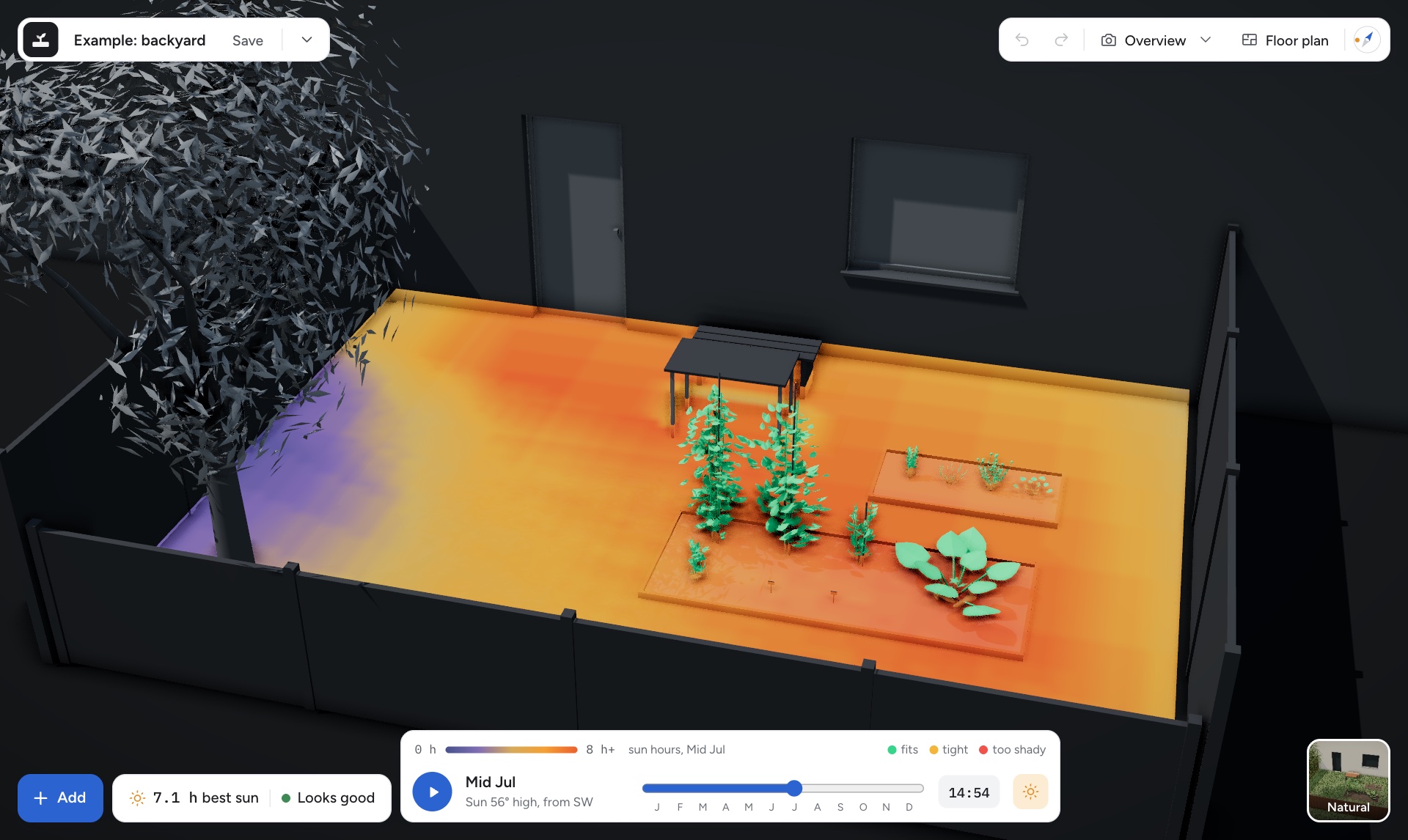
The Based Garden planner showing an example backyard in mid July, with a heat map of direct sun hours across the ground, and shade from a tree in purple.

Know what has to be true before you build

Gardeners guess how sunny a spot is, and guesses miss roofs, parapets and fences. Sun apps can't see a balcony roof and give no plant advice. Bed planners make you type the sunlight in yourself.

What we built

You take five photos, give the size and say what shades the space: a building opposite, a tree, a neighbor's wall. The app works out the direct sun on each spot through the season, and says what will grow where.

A season slider grows, flowers and fades each plant, so you can see July before you buy anything in April. A garden check flags crowded plants, shallow soil and blocked doors.

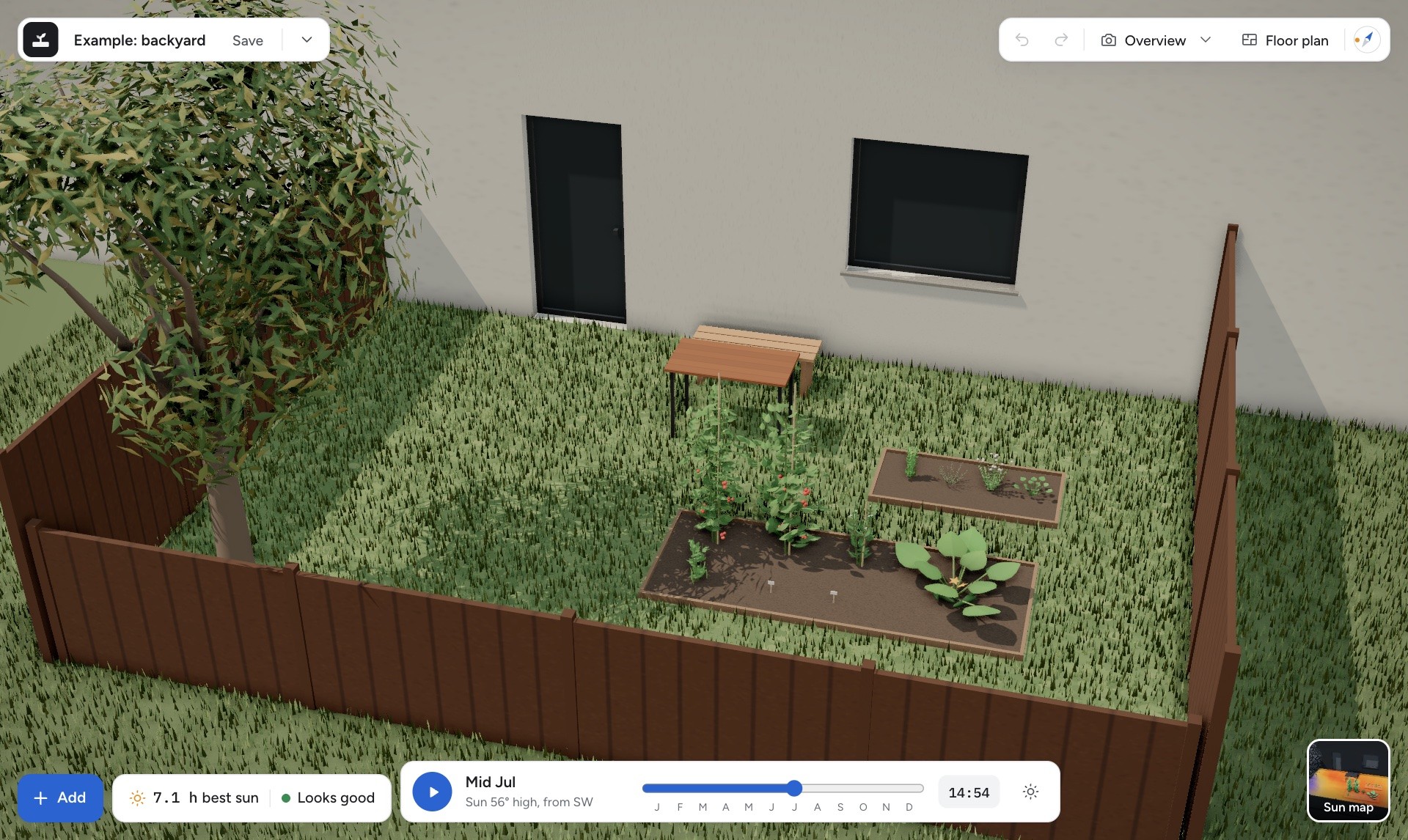
The Based Garden planner in 3D: an example backyard in mid July with tomatoes, peppers and a zucchini growing in two ground beds, a tree and a fence.
  • 45season passes a year to break even, estimated
  • 10 cmsun worked out per cell
  • 50crops in the library
  • 345automated tests, all passing

Plan it for me

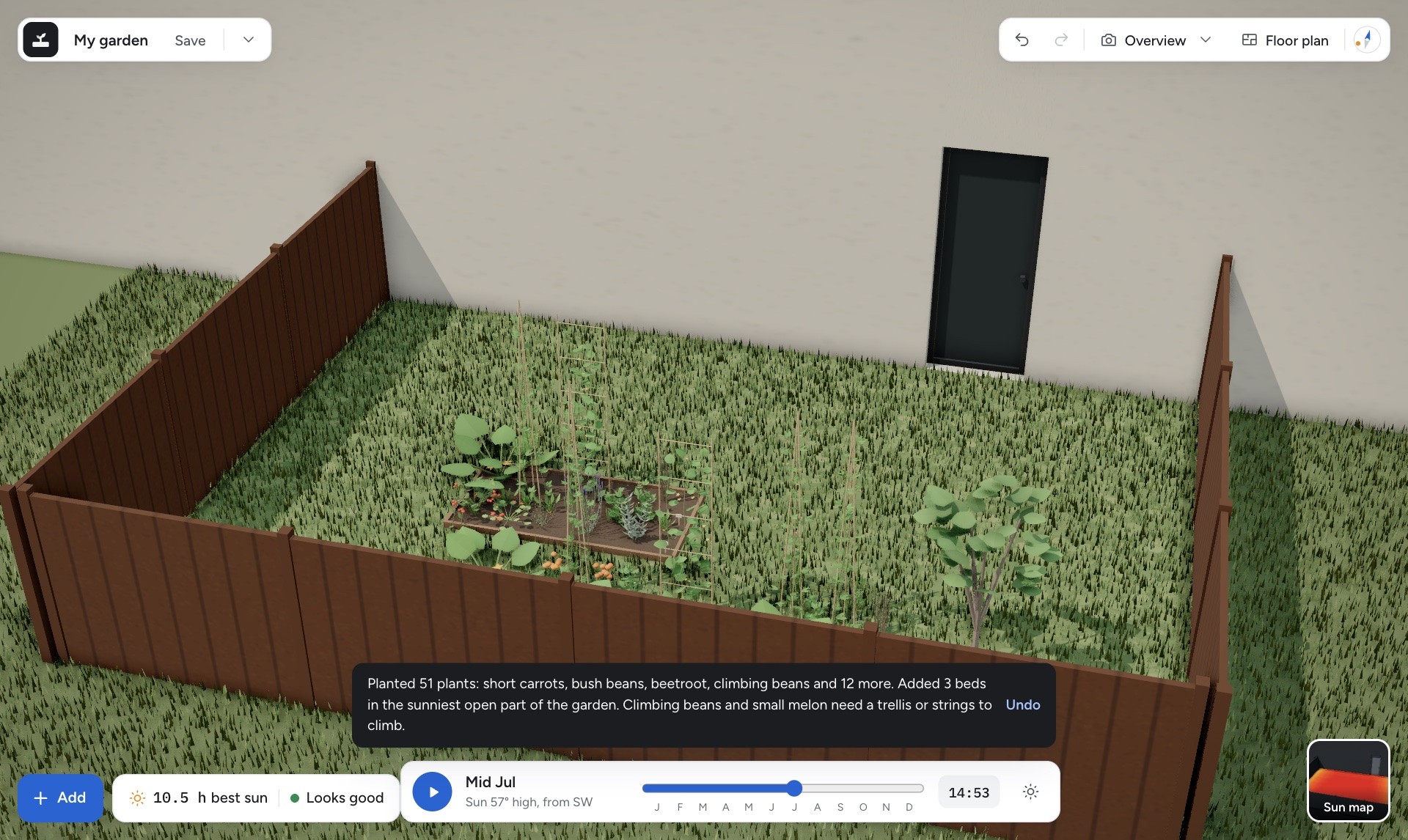
One button places beds in the sunniest open part of the space and fills them with crops that fit the sun there. It says what it did, such as which plants need a trellis, and one click undoes it.

The plan goes home as a shopping list and a calendar file.

An example garden in Based Garden after Plan it for me: three beds placed in the sunniest open part, with 51 plants and a note on which crops need a trellis.

The sums, before the paid version

We did this before building the paid version. A season pass costs €14.99 for one growing year, with 5 space readings and 25 object readings. After VAT, fees and typical AI use, about €9.50 is left.

Running costs are roughly €420 a year. So break-even is about 45 season passes a year.

The first target is 200 waitlist sign-ups and 10 paying users, three months after launch. These are estimates until real payments replace them.

What has to be true

We wrote down the assumptions that could sink it, and how to test each one. Will amateurs type two measurements and take 3 to 5 photos? We test that with 5 people. Will they pay €14.99 a season? We test that on the paywall.

One assumption already changed. People with a backyard plant straight into the soil, so a ground bed became a first-class growing area and not a kind of planter.

What we left out, and why

AI in the free sample

Anyone can try prepared example spaces with no account. Reading your own photos uses AI, which costs money on every run, so it comes with the season pass.

Automatic renewal

A season pass covers one growing year and then ends. Gardeners buy for a season, not a subscription.

Keeping your photos

Photos are deleted 30 days after the reading. The plan needs the measurements, not the pictures.

Where it stands

The paid app is built and runs on test services so far: email sign-in, payment, guided photos, the sun reading, Plan it for me, saved spaces and share links. A private beta starts in January 2027, and the paid version is planned for February 2027.

Before then, the first readings of real photos decide whether it ships as planned. It has no paying users yet, and it is a consumer product, so it says nothing about regulated industries.

For the technical reader

A sun number you can check

A sun number is only useful if it's right. So the model's answers for example spaces are pinned as tests, and any engine change has to keep them or explain why.

Space modelShape, walls, roof and shade from around the space
OccludersThe boxes that block sun, shared by the 3D view and the tests
Sun modelSolar position, then rays cast per 10 cm cell
AdviceCrop fit judged per spot, plus the garden checks
Next.js 15, React 19, TypeScript and Three.js, with the engine in plain TypeScript.

What the tests pin down

These are season averages of direct sun in hours, late April to September, for the front, middle and back of each space. Every test run checks them.

npm test: expected sun per space
North balcony  1.8  0.4  0.3
South terrace  8.8  9.2  9.1
West loggia    0.5  2.2  2.6
Backyard       4.8  7.1  6.9
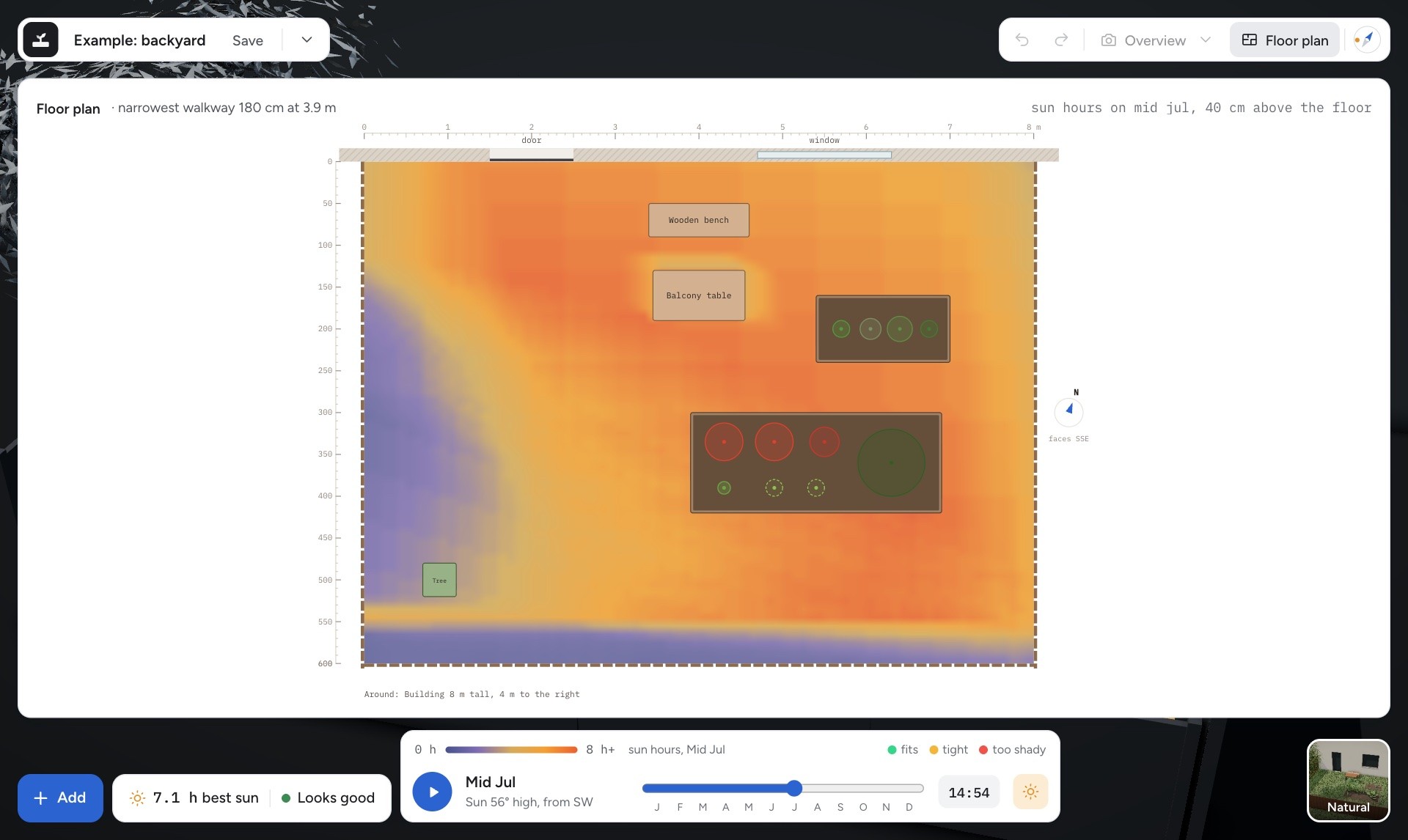
The Based Garden floor plan in centimetres, with a heat map of sun hours in mid July, the shade of a tree in purple and two planted beds.

Three hard problems

An engine built for one terrace had to handle any space

The problem

The first version modelled one terrace: a wall behind blocked every ray, and nothing outside the space cast shade.

What we decided
The settings grew into a space model in small steps. Every new field has a default that reproduces the original terrace, so saved designs keep loading.
What it cost us
The code still says Terrace in places where it now means any space.

The picture and the numbers must agree

The problem

If the shadow on screen and the sun hours came from different geometry, nobody could trust the advice.

What we decided
One set of occluder boxes feeds both the 3D view and the tests, so the shade you see is the shade being counted.
What it cost us
Anything that needs WebGL stays out of the tests. The 3D view itself is still checked by eye.

Heavy 3D inside a React app

The problem

A 3D scene redraws many times a second while you drag things around it. Sending that through React would be slow and hard to reason about.

What we decided
The engine is plain TypeScript and updates the page directly. React renders the layout once and stays out of the way.
What it cost us
A layout has to follow a written contract of element ids, and TypeScript can't check that contract.

How we checked it

All 345 automated tests pass, run on November 16, 2026: 173 unit tests, 94 against a real database and 78 browser checks on desktop, phone and the garden flow. The sun numbers above are pinned in the unit tests, so any engine change has to keep them or explain why.

What the agents did, and what people did

Agents worked from discovery through to the paid app, and co-authored 63 of the 77 commits. A person confirmed the scope, the caps and the price, chose the layout from three prototypes and set the launch dates.

What this means for your process

Your process isn't a balcony, but the method carries over. Write the sums down first, cut what the first version doesn't need and pin the numbers that matter as tests.

The First Workflow gives you a working version of your own process, plus a fixed price to put it into use, so you can do the sums before you commit.

Have a process like this?

Book a 20-minute call

You describe the process. If a First Workflow fits, you get a one-page proposal within 2 working days. If it doesn't, we say so.

Book a call

You'll talk to Sandi, our founder. No slides.

Not ready for a call? Send us the process in writing. We reply within one working day.

Free download

The First Workflow kit: find the process worth turning into software

Ten signs a process is ready, what AI can do in a back office today, a worksheet to price your process, build or buy and the questions to ask any software vendor. Seven pages, written for people who run operations.

Want our eyes on your process? Get a free scorecard
We use your email for this and, if you tick the box, the Letter. Unsubscribe with one click. See our privacy policy.
Book a 20-minute call