Sitnish - A money app that will never ask for your bank login

Sitnish tracks personal and household money from sentences you type, with no bank connection. It replaces the spreadsheet that shows where money sits but never where it goes.

  • Product
  • Built, launching soon
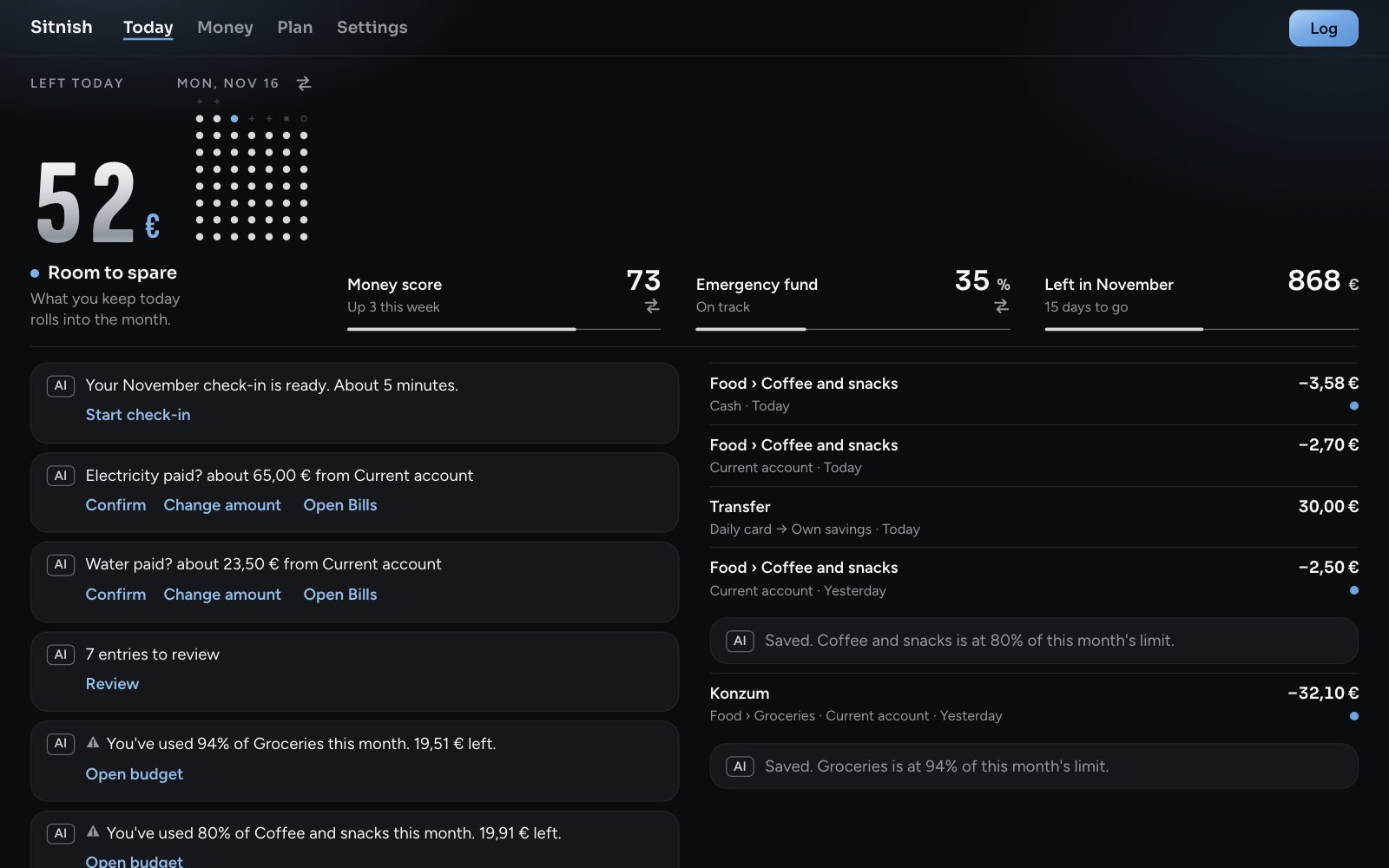
The Sitnish web app on made-up data: left to spend today, a money score, an emergency fund tracker, the assistant's cards and the latest entries.

Where the money goes, not just where it sits

It started with one household's Excel workbook. Every month meant typing balances by hand and copying totals between sheets. It showed where money sat and never where it went.

What we built

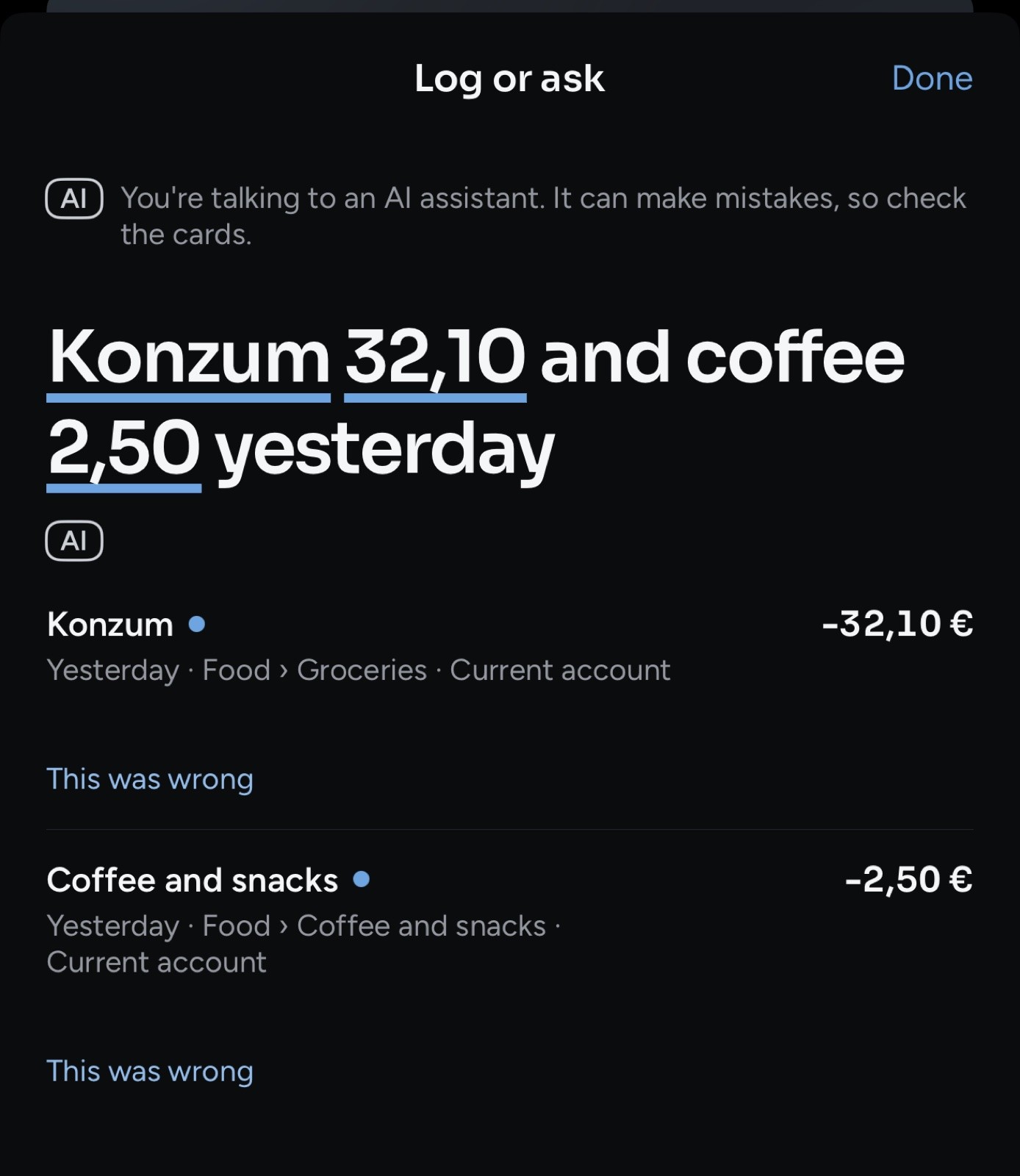
You log spending by typing a sentence, such as "Konzum 32,10 and coffee 2,50 yesterday". The app saves the entries, picks the categories and takes the money off the right account.

Two adults can share a household, and each account can be shared, balance-only or private.

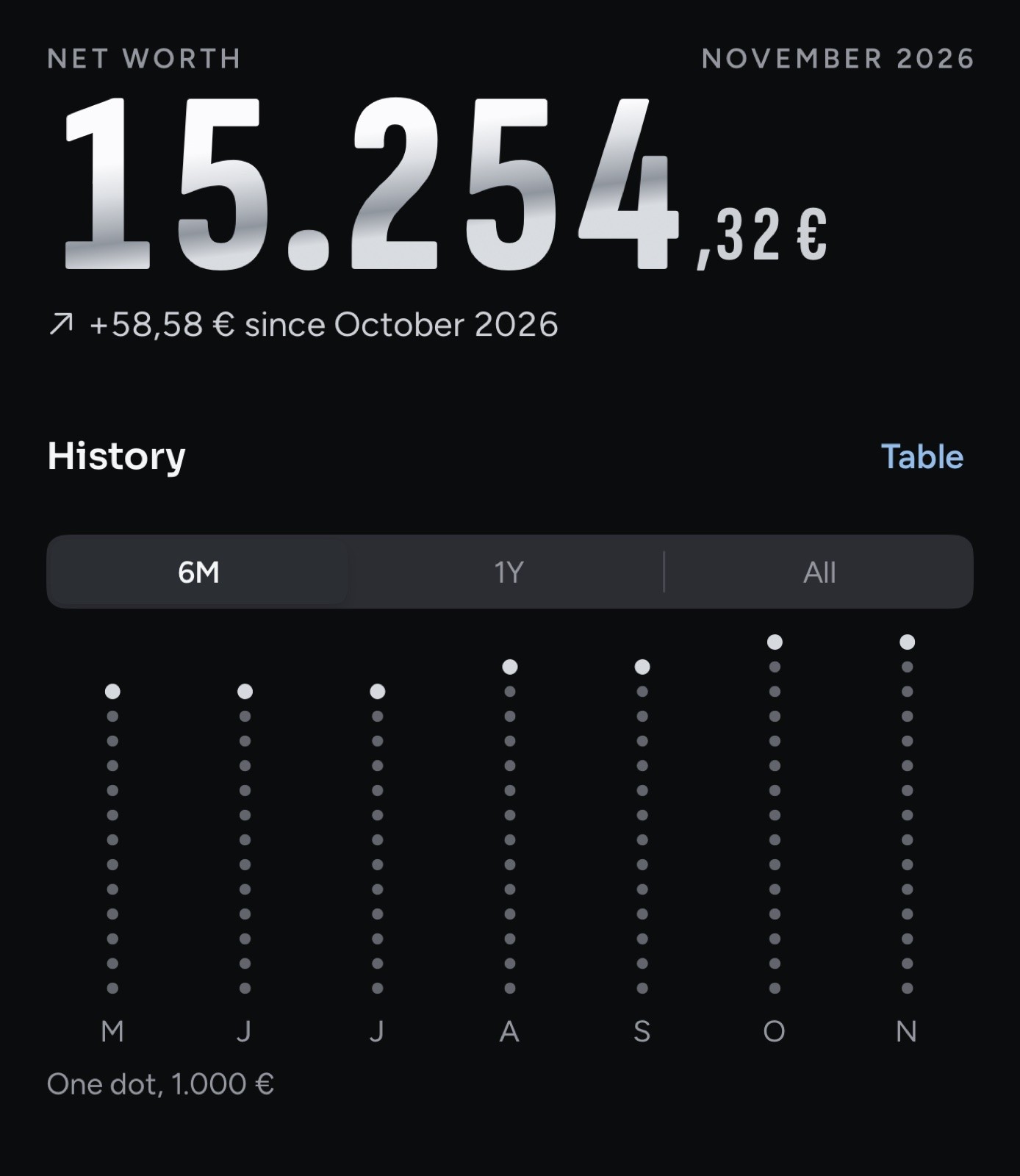
Sitnish on iPhone: a typed sentence, Konzum 32,10 and coffee 2,50 yesterday, becomes an entry with a category and an account.The net worth screen in Sitnish on iPhone, with six months of history drawn as columns of dots, on made-up data.
  • 2,347API, web and infrastructure tests passing
  • 22days from first commit to full demo
  • 93API paths
  • 46database tables

A monthly check against reality

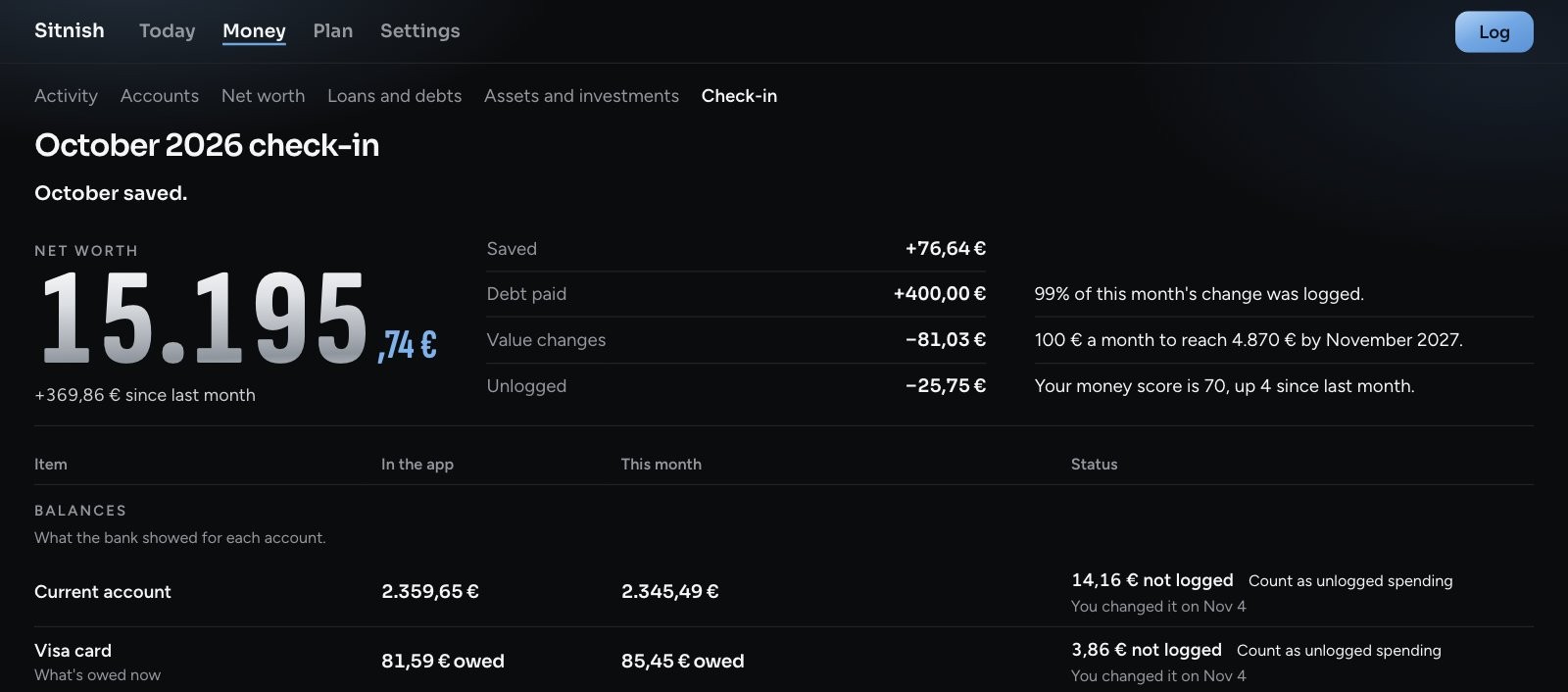
People forget to log things. So once a month, the app asks for the real balances and counts any gap as unlogged spending. The numbers stay honest even when the logging isn't.

If your team reconciles a ledger against a bank statement, this is the same control in a smaller place.

A saved monthly check-in in Sitnish on made-up data: net worth, what was saved, debt paid, value changes and unlogged spending, with the balances below.

The line the assistant won't cross

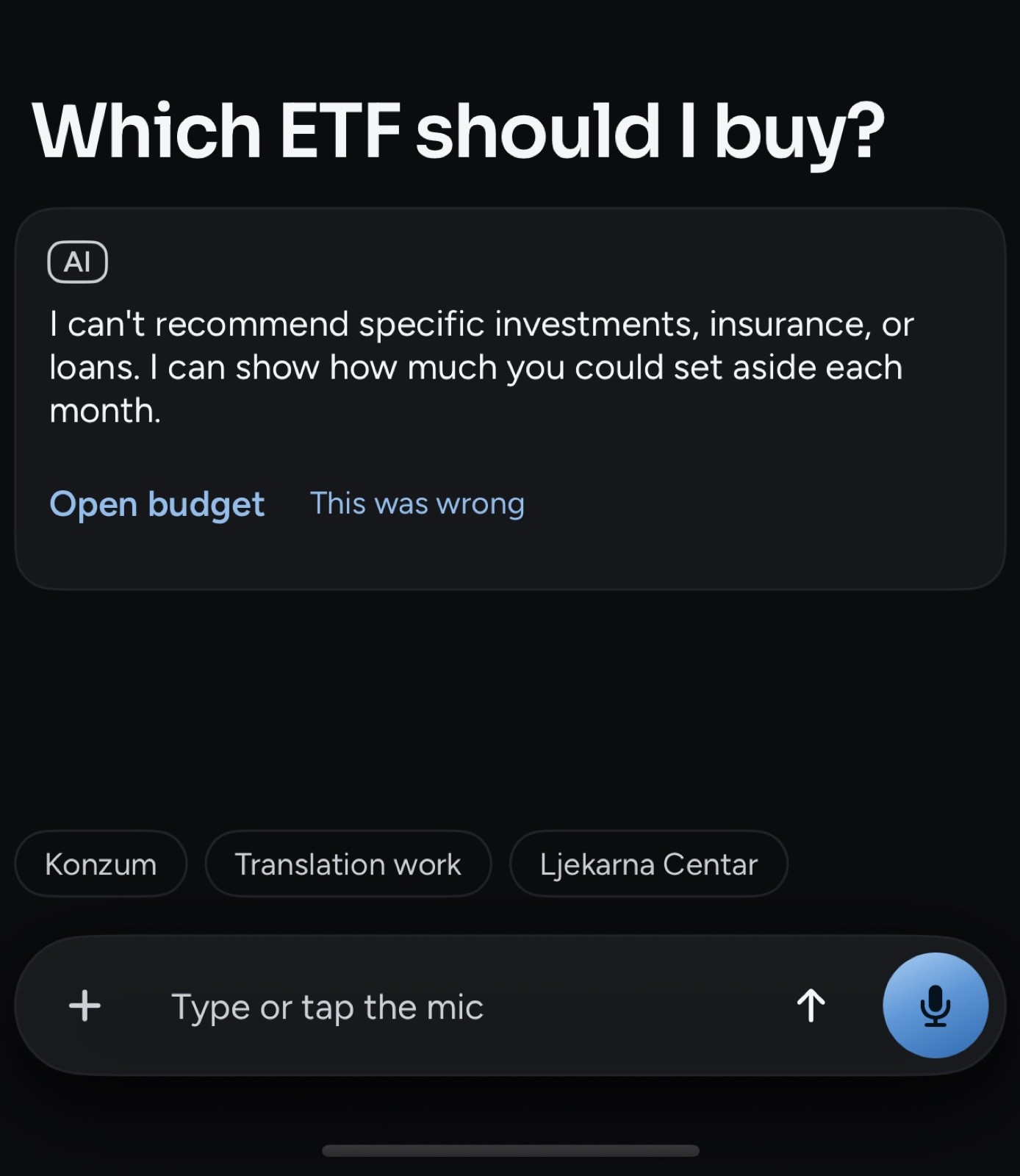
Ask which ETF to buy and it declines, then offers to show how much you could set aside. A budgeting app shouldn't act like an adviser.

These screens come from our demo, on made-up data, with a local stand-in for the AI model. They show the rule and the screen, not a live model.

Sitnish on iPhone: asked which ETF to buy, the assistant declines to recommend investments, insurance or loans and offers to show how much could be set aside.

Where it fits in the market

We looked at about 25 money apps in October 2026, in the app stores of two markets. None of them combined entry by chat with a full household model. Some had the entry but no net worth or roles. Others had roles but no chat.

Paying users haven't proved that gap yet, so the plan ships in two steps. First one household uses it daily and approves the look and feel. Then a public beta starts.

What we left out, and why

Bank connections

Never, by design. An app that holds no bank login has no bank login to lose.

Android, Watch and widgets

The first release had to prove that one iPhone app gets opened every day.

The web app, at first

We cut it from the first release to save time. It came back as the second release, once the core worked.

What it costs and earns

One person can use it free, with 100 assistant messages a month. Plus adds the household and 1,000 messages a month, at €4.99 a month or €39 a year, with a 14-day trial. We estimate the model at about $5 per active user per year, and hosting at tens of dollars a month.

Where it stands

Sitnish is built: the iPhone app, the web app and a landing page with a waitlist. It launches soon, first on TestFlight and then in the App Store. Until then it has no users or revenue. Before public release, the spec requires a data protection impact assessment, a breach plan and a lawyer's review.

For the technical reader

Two locks on every household's data

In a money app, a small bug can become a serious one. So the API checks who can see what, and then the database checks again.

iPhone appSwiftUI, saves entries offline
Web appReact, signs in with an HttpOnly cookie
Fastify APIZod schemas, household checks on every request
PostgreSQLRow-level security per household
Claude on BedrockPlanned: EU region, invocation logging off
Fastify, Drizzle, PostgreSQL, SwiftUI and React, with AWS in the EU planned for hosting.

Three hard problems

One missing filter must not show a family's money to another

The problem

A shared database holds many households. Code review alone can't promise that no query ever forgets its household filter.

What we decided
The API checks first. Row-level security is the second net: every statement sets the household id, so a query that forgets its filter finds nothing of anyone else's.
What it cost us
Every statement runs inside a transaction that sets the household. The few flows that move rows between households need an explicit second permission.

An entry has to save in a shop with no signal

The problem

Logging has to be instant, or people stop doing it. Waiting for the server isn't an option on a phone.

What we decided
The phone generates each id itself, as a UUIDv7. Changes wait in an outbox and sync through a cursor, and a field history keeps every change.
What it cost us
The phone holds real logic now, so some rules live in two languages and have to stay in step.

One sentence, three parsers, one answer

The problem

"Zara 49.99 and H&M 25 on card" must mean the same thing on the API, the web and the iPhone.

What we decided
Simple lines save on the device without calling the model. A shared fixture file sets the expected results, and a script runs it on the phone too.
What it cost us
Any parser change means updating the fixture and rerunning it on a simulator.

Privacy rules we wrote down before building

The spec says logs and analytics carry ids only, never amounts, merchants or text. Coding agents never get production credentials or production data, and every outside service has a local fake.

Discovery used one household's real figures. A script fails if any of them turns up outside that document. We ran it on November 16, 2026, and it found none in 1,191 files.

How we checked it

All 2,347 automated tests on the API, web and infrastructure pass, run on November 16, 2026. The iPhone suite ran the same day: 534 of its 536 tests passed and 2 were skipped.

The assistant has its own evaluation set of 124 entries, 35 questions, 10 off-topic messages and 45 guardrails. Until the app is deployed it runs on the local stand-in, so it proves nothing about the live model yet.

What the agents did, and what people did

One agent session went from discovery to ticket 21 over three days: 2,811 tool calls in 802 active minutes. A third of those calls went on checking the iPhone app by hand, so we added automated UI tests.

Agents co-authored 343 of the 363 commits. A person made the product decisions, and a person holds every account and secret.

What this means for your process

Your process probably holds data as sensitive as this: client portfolios, policies, invoices. The same two locks apply, and so does the rule that agents never touch production data.

The First Workflow gives you a working version of your own process, on made-up data, built the same way.

Have a process like this?

Book a 20-minute call

You describe the process. If a First Workflow fits, you get a one-page proposal within 2 working days. If it doesn't, we say so.

Book a call

You'll talk to Sandi, our founder. No slides.

Not ready for a call? Send us the process in writing. We reply within one working day.

Free download

The First Workflow kit: find the process worth turning into software

Ten signs a process is ready, what AI can do in a back office today, a worksheet to price your process, build or buy and the questions to ask any software vendor. Seven pages, written for people who run operations.

Want our eyes on your process? Get a free scorecard
We use your email for this and, if you tick the box, the Letter. Unsubscribe with one click. See our privacy policy.
Book a 20-minute call