Specbrew - Discovery calls that end with a clickable prototype

Specbrew listens to a client discovery call on the Mac, with no bot in the call. Two agents keep a spec and a clickable prototype up to date while people talk, so both are ready minutes after the call ends.

  • Product
  • In build, design approved
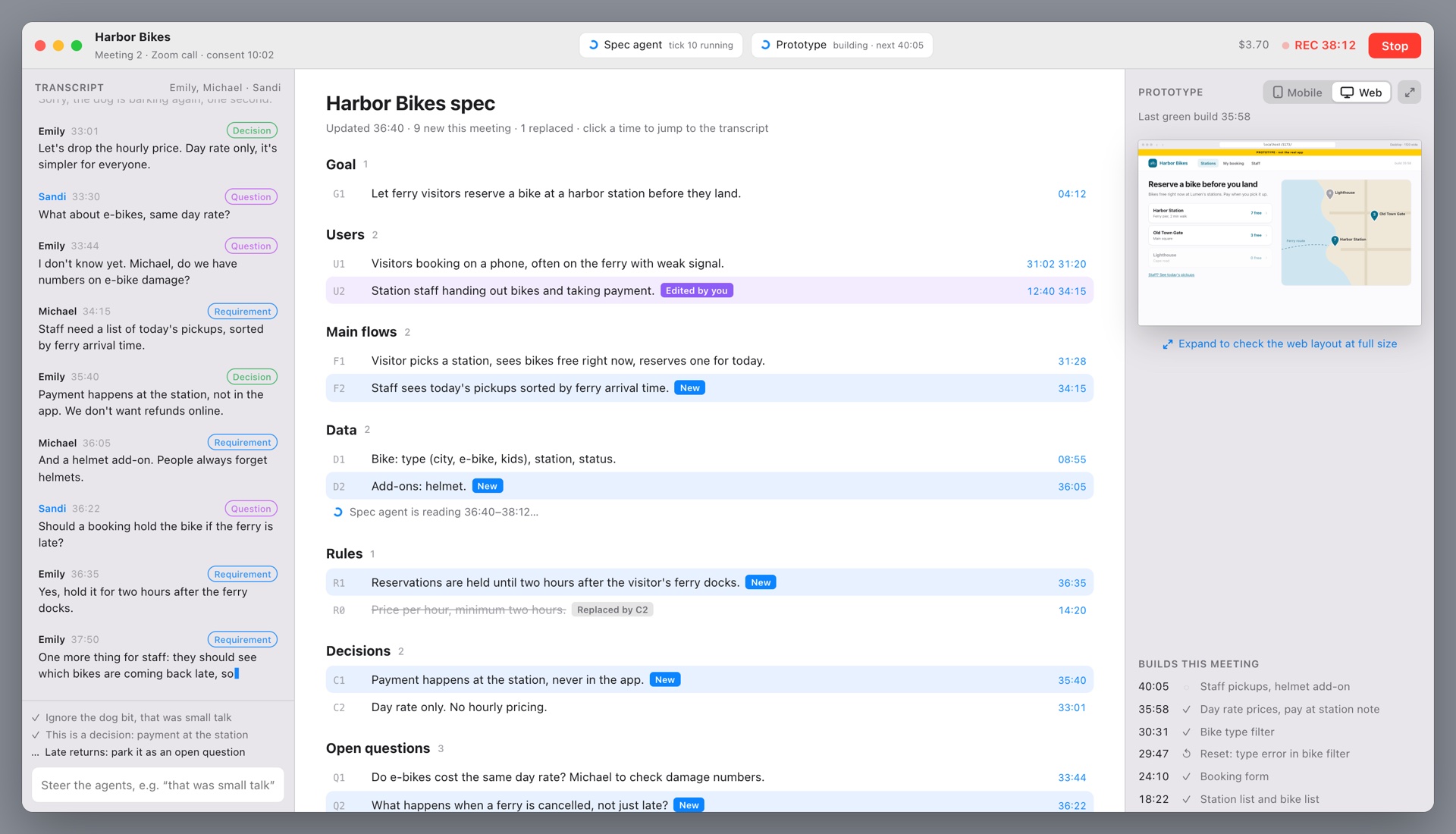
The Specbrew window from the approved design, mid-meeting: a tagged transcript, the spec with new and edited items, and the prototype preview.

The call ends, and the prototype is already there

After a discovery call, writing it up takes a day. A prototype follows a week later. By then the client has cooled off. Specbrew keeps the spec and a clickable prototype up to date while people are still talking.

What it does

A consultant starts Specbrew on their Mac before a client call. No bot joins the call. Specbrew writes down what each person says and tags each line as a decision, a requirement or a question.

Two agents work from that. One keeps a spec with seven sections: goal, users, main flows, data, rules, decisions and open questions. Every item links to the moment in the call it came from. The other builds a clickable prototype from the spec and rebuilds it every few minutes.

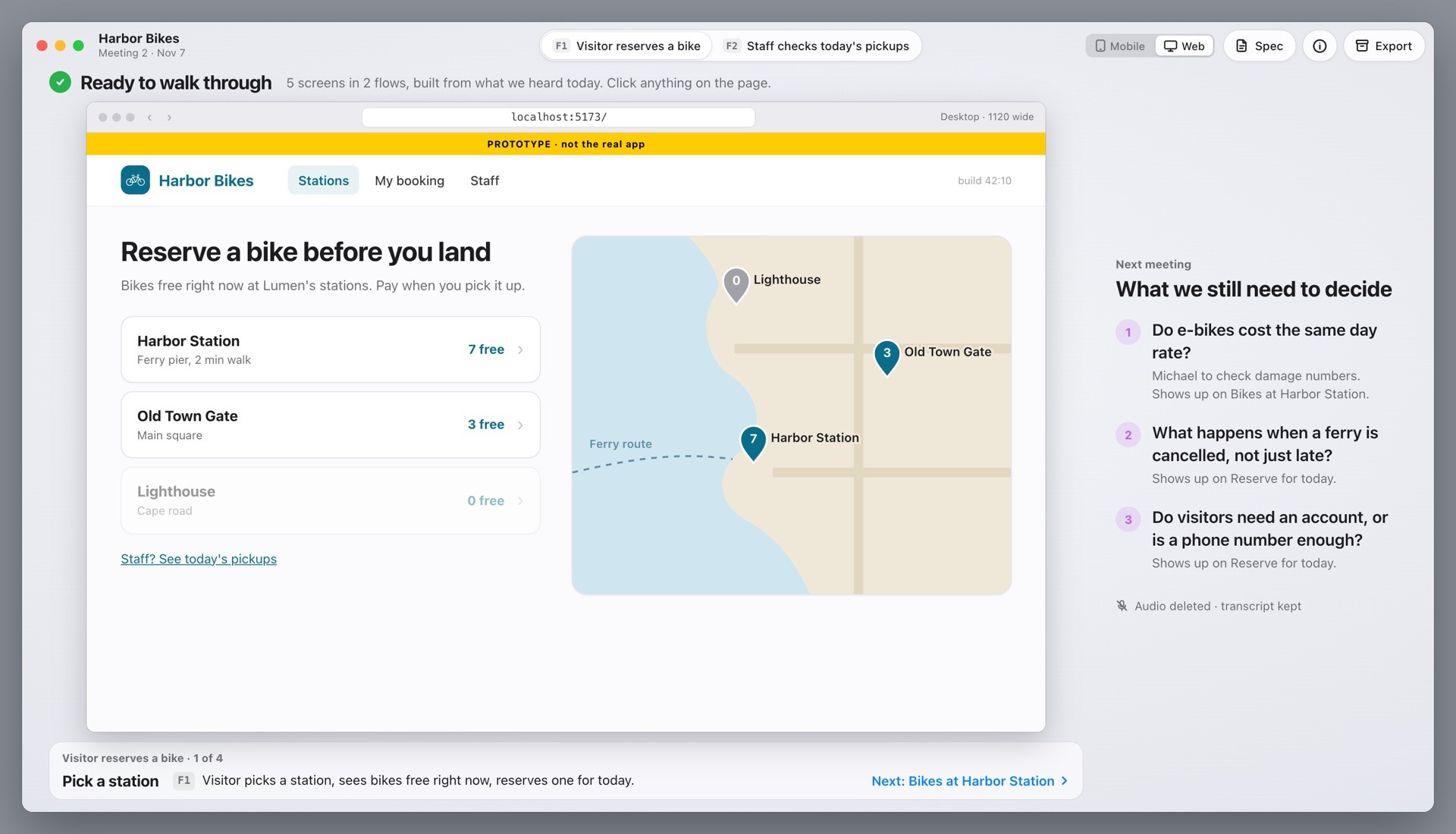
When the call ends, a last pass takes a few minutes. Then the consultant can walk the client through the prototype, with the questions for the next meeting beside it.

The Specbrew ready screen from the approved design: a clickable prototype of a bike booking site for an example client, with the open questions for the next meeting beside it.
  • 5 mintarget from the end of the call to a clickable prototype
  • 7spec sections, each item linked to the moment it was said
  • $9estimated model cost for an hour-long meeting
  • 29automated tests on the spec store, all passing

People stay in charge

Edit an item by hand and the agents never overwrite it. They can only propose a change. Nothing gets deleted: a replaced item stays, crossed out, with what replaced it.

While the call runs, the consultant can steer in plain words, such as "that was small talk" or "that's a decision".

If your team writes up client calls, claims calls or onboarding interviews by hand, this is the same job.

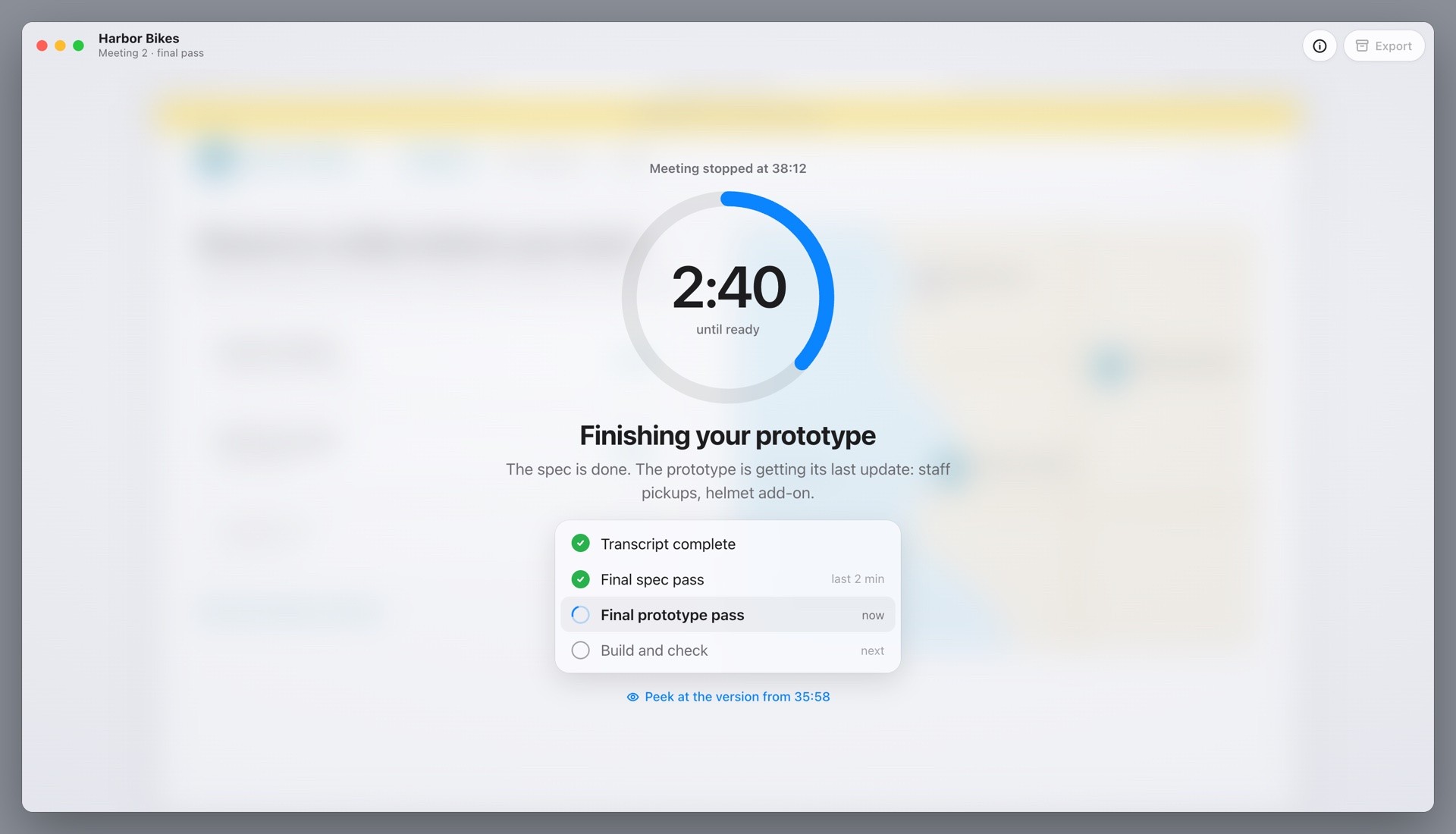
The Specbrew screen after the meeting stops, from the approved design: 2 minutes 40 until ready, with the final spec pass done and the final prototype pass running.

What we left out, and why

Selling it

Version 1 is our own tool for our own discovery calls. We decide whether it becomes a product after 10 real meetings.

A server

Each project is a folder on the consultant's Mac, and no audio is kept. Client conversations don't sit on a server we run.

Windows and other languages

The first version runs on macOS, in English. The audio capture it needs is specific to the Mac.

What it costs

We estimate about $9 in model costs for an hour-long meeting, and about $18 with the larger model. Transcription costs $0.27 per audio hour. These are estimates until real meetings replace them.

Where it stands

The spec and the design are approved. Sandi picked the design from ten variants of each main screen. The first part, the store that keeps the spec, is built and tested. The app, the audio capture and the agents come next.

Before the first client call, it has to pass three checks: a review of its output, a legal check on recording consent and a design brief. It hasn't been used with a client yet.

For the technical reader

Agents that can't break the demo

A prototype that crashes in front of the client is worse than none. So every change an agent makes has to build, and a failed build goes back to the last one that worked.

Mac appSwift, with Core Audio taps: microphone and call audio as separate channels
TranscriptionAssemblyAI streaming, with each speaker kept apart
SidecarNode on the Claude Agent SDK, one per project, talking over stdio
Spec agentEvery 4 minutes
Prototype agentEvery 5 minutes, then a build
Swift on macOS 14.2 or later, TypeScript in the sidecar, Claude models through the Agent SDK, and a git repository per project.

A website or a phone app, set per project

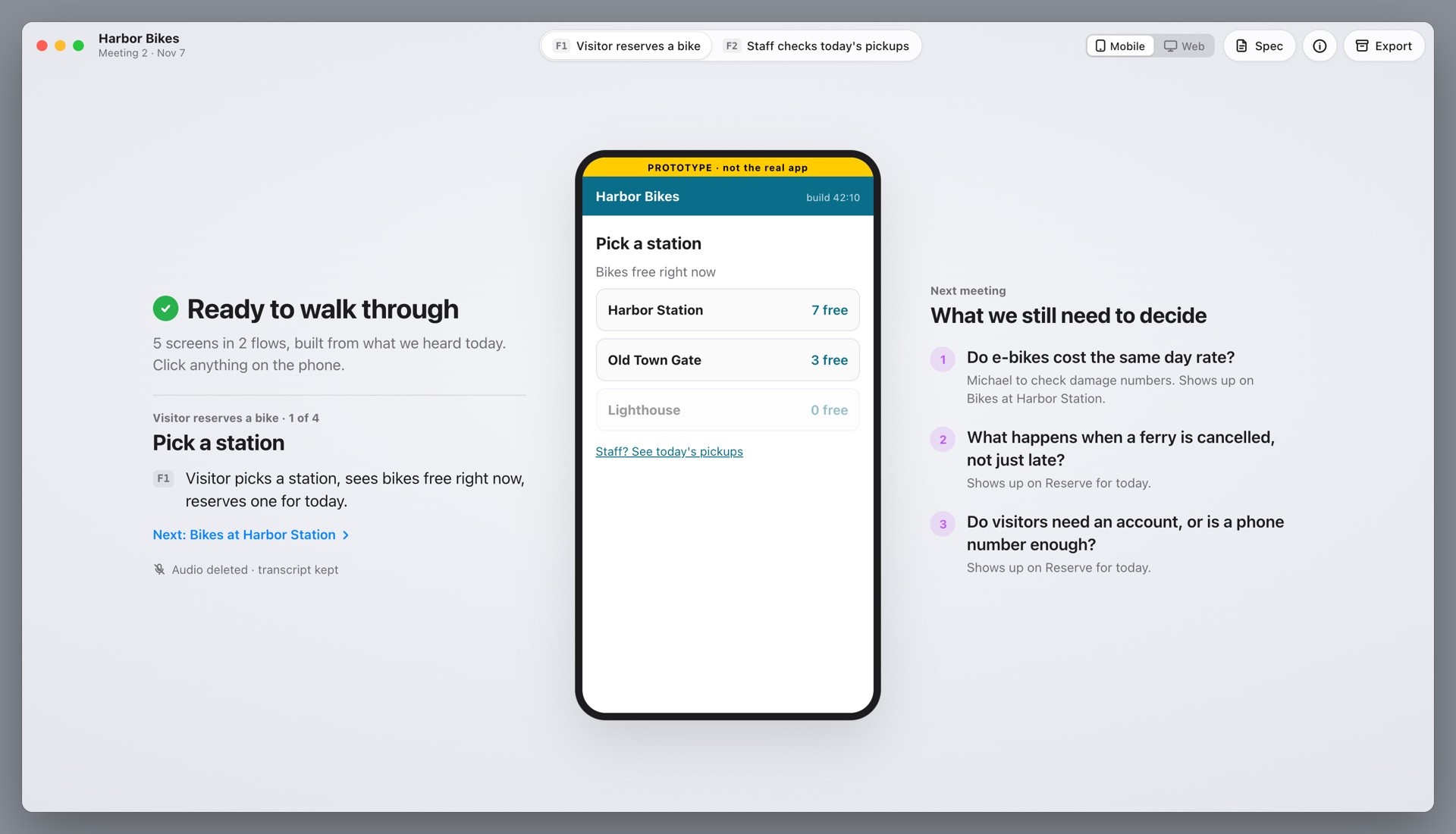
Each project records whether the client's product is a website or a phone app, and the prototype is built for that. The preview can also switch between phone and desktop size while the consultant walks the client through it.

The Specbrew ready screen from the approved design, showing the example prototype at phone size, with the open questions for the next meeting.

Three hard problems

An agent can break the prototype mid-meeting

The problem

An agent that rewrites a working page during a live call can leave it broken just when the client looks at it.

What we decided
The prototype starts from a fixed template. Its agent sees only changes to the spec, never the raw transcript. Every round ends with a build, and a failed build resets to the last one that passed.
What it cost us
The preview can lag behind the conversation, and the consultant only ever sees the last build that passed.

Hearing the call without a bot

The problem

No bot should join the call, and it has to work the same in a meeting room as on any call app. So listening happens on the consultant's own machine, and no audio is kept.

What we decided
A native Mac app captures the call's audio directly. The agents run in a Node sidecar, because the Agent SDK has no Swift version.
What it cost us
It runs only on the Mac, the message types are written twice in two languages, and shipping Node makes the app about 500 MB.

Trusting a spec an agent wrote

The problem

A spec is only useful if you can check where each line came from, and if your own corrections stay put.

What we decided
Agents can only add, update or replace structured items. Nothing is deleted, hand edits are never overwritten, and every item cites the moment it came from.
What it cost us
Items have more states (new, edited by hand, replaced, proposed), and the spec's history only grows.

How we checked it

All 29 automated tests on the spec store pass, run on November 16, 2026. The bar for version 1 is in the spec: ready within 10 minutes of the end of the call, in 3 of the first 5 meetings.

What the agents did, and what people did

Agents co-authored 14 of the 15 commits: the spec, the decision records, the research, the design variants and the code. Sandi approved the spec, picked the design and holds the three checks before first use.

What this means for your process

A First Workflow starts with a call about your process. Specbrew is how we want to end that call with a spec and a prototype you can click through, not a promise of one next week.

The rules are the ones on this page: every line traces back to what you said, your corrections stay put and nothing broken reaches the screen.

Have a process like this?

Book a 20-minute call

You describe the process. If a First Workflow fits, you get a one-page proposal within 2 working days. If it doesn't, we say so.

Book a call

You'll talk to Sandi, our founder. No slides.

Not ready for a call? Send us the process in writing. We reply within one working day.

Free download

The First Workflow kit: find the process worth turning into software

Ten signs a process is ready, what AI can do in a back office today, a worksheet to price your process, build or buy and the questions to ask any software vendor. Seven pages, written for people who run operations.

Want our eyes on your process? Get a free scorecard
We use your email for this and, if you tick the box, the Letter. Unsubscribe with one click. See our privacy policy.
Book a 20-minute call