Tracker Of Us - One app for running a team, where AI agents can't close their own work

Tracker Of Us puts tasks, sprints, time off and team availability in one app. Agents do real work in it, and people test and close it.

  • Product
  • In daily use, production launch soon
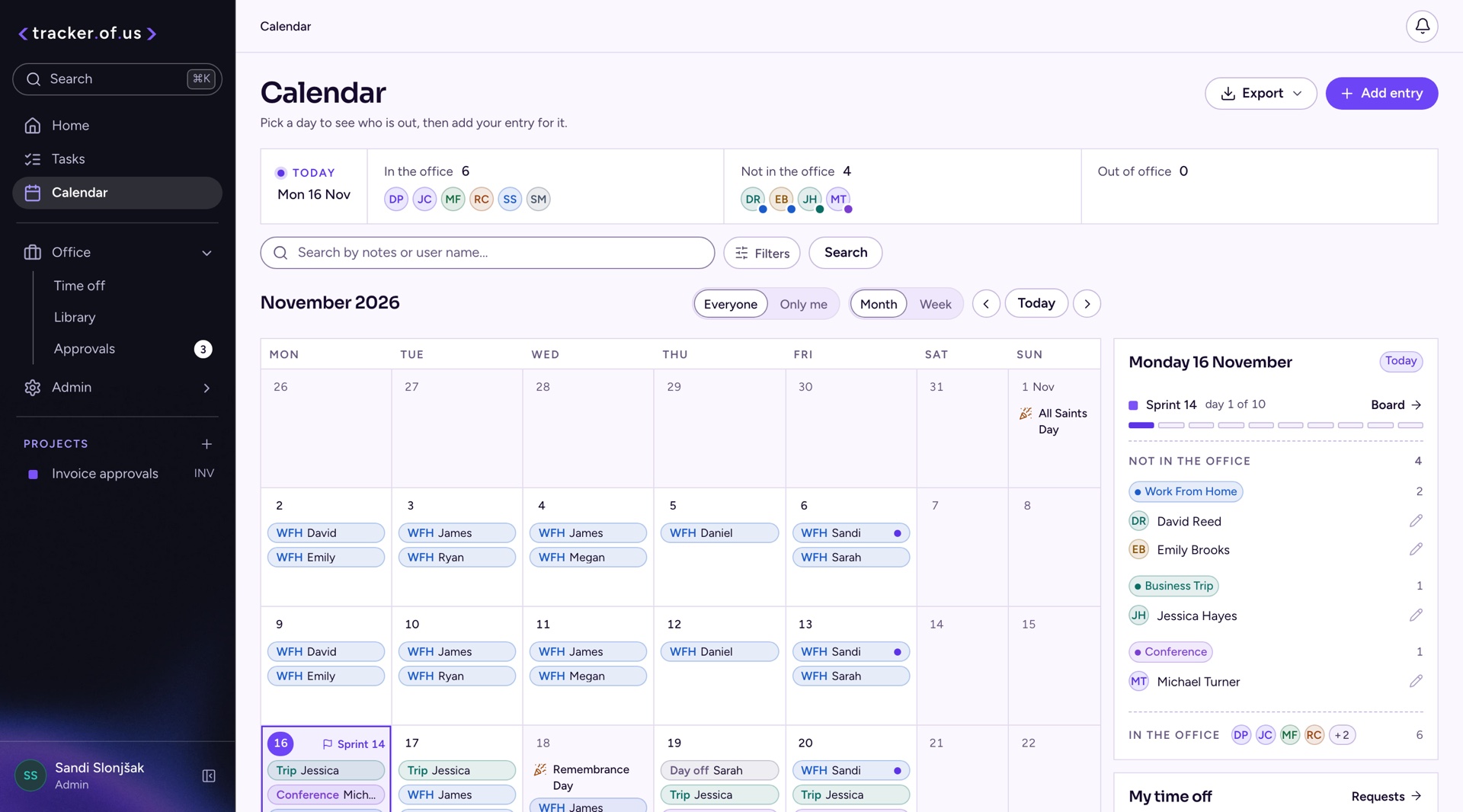
The Tracker Of Us calendar: who is in the office today, who works from home or travels, and the month of entries for the team.

One place for the questions a team asks all day

Who has this task? How long has it waited? Who is out on Thursday? Those answers used to sit in different tools. Now one app holds them.

The problem

Take a team of 12 across two offices, working on several projects at once. Presence and time off sat in one place. Tasks sat in a tool built for a different job, plus a few scattered others.

So one small question could mean opening two or three tools. Nobody could see in one place what a colleague was working on and whether they were in.

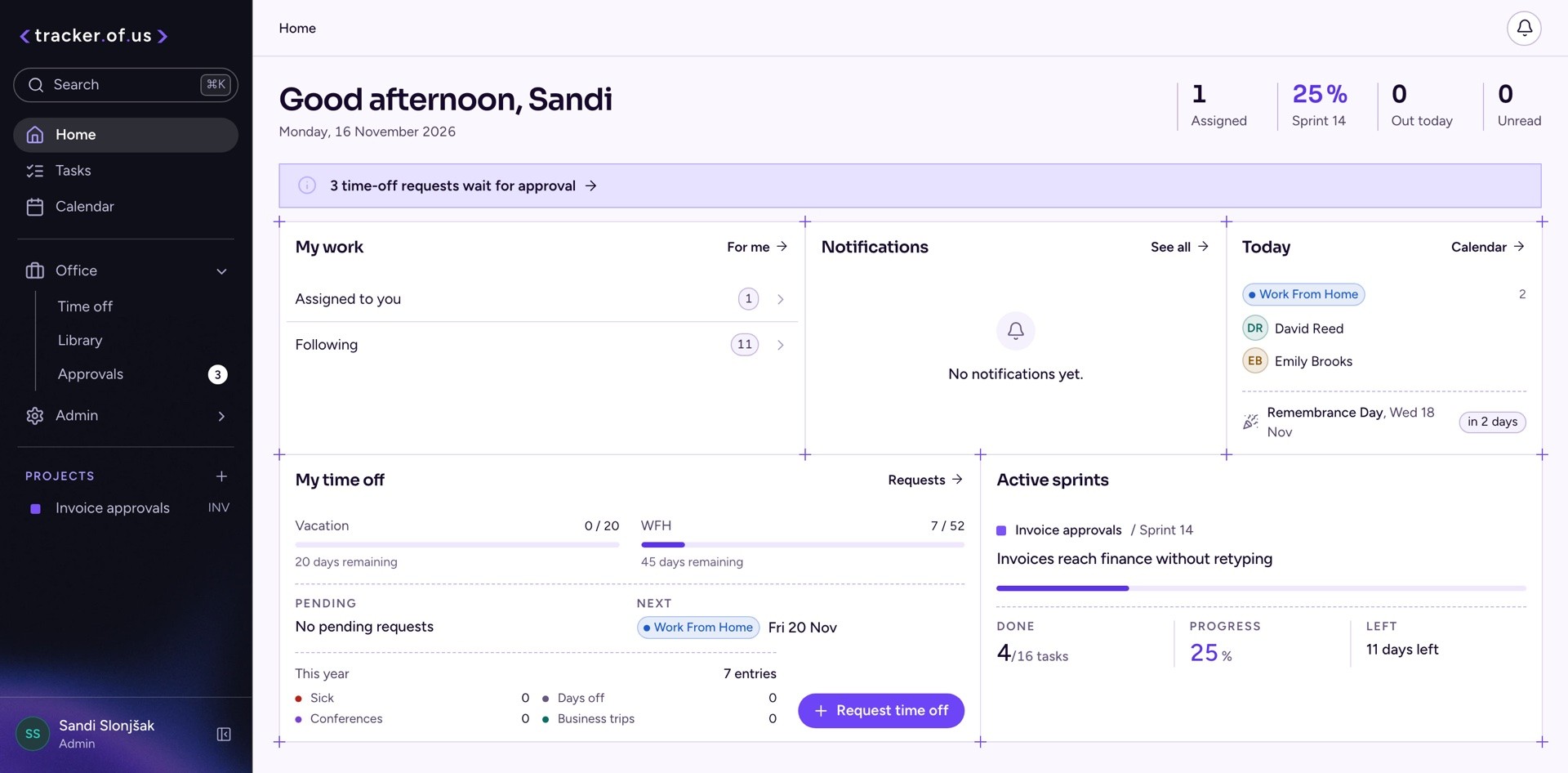
The Tracker Of Us home screen: time off requests waiting for approval, my work, who works from home today, time off left and the active sprint.
  • 4,304automated tests
  • 268API endpoints
  • 32screens
  • 10tools agents can use

What we built

Every task has one person holding it. The app counts the working days it has waited with them, and company holidays don't count.

Before a task is handed over, it has to say what done means. Before it closes, someone has to say how it was tested. Every step goes into the task's history, and nobody can edit it.

If your team chases approvals or invoices by email, this is the same problem with a different noun.

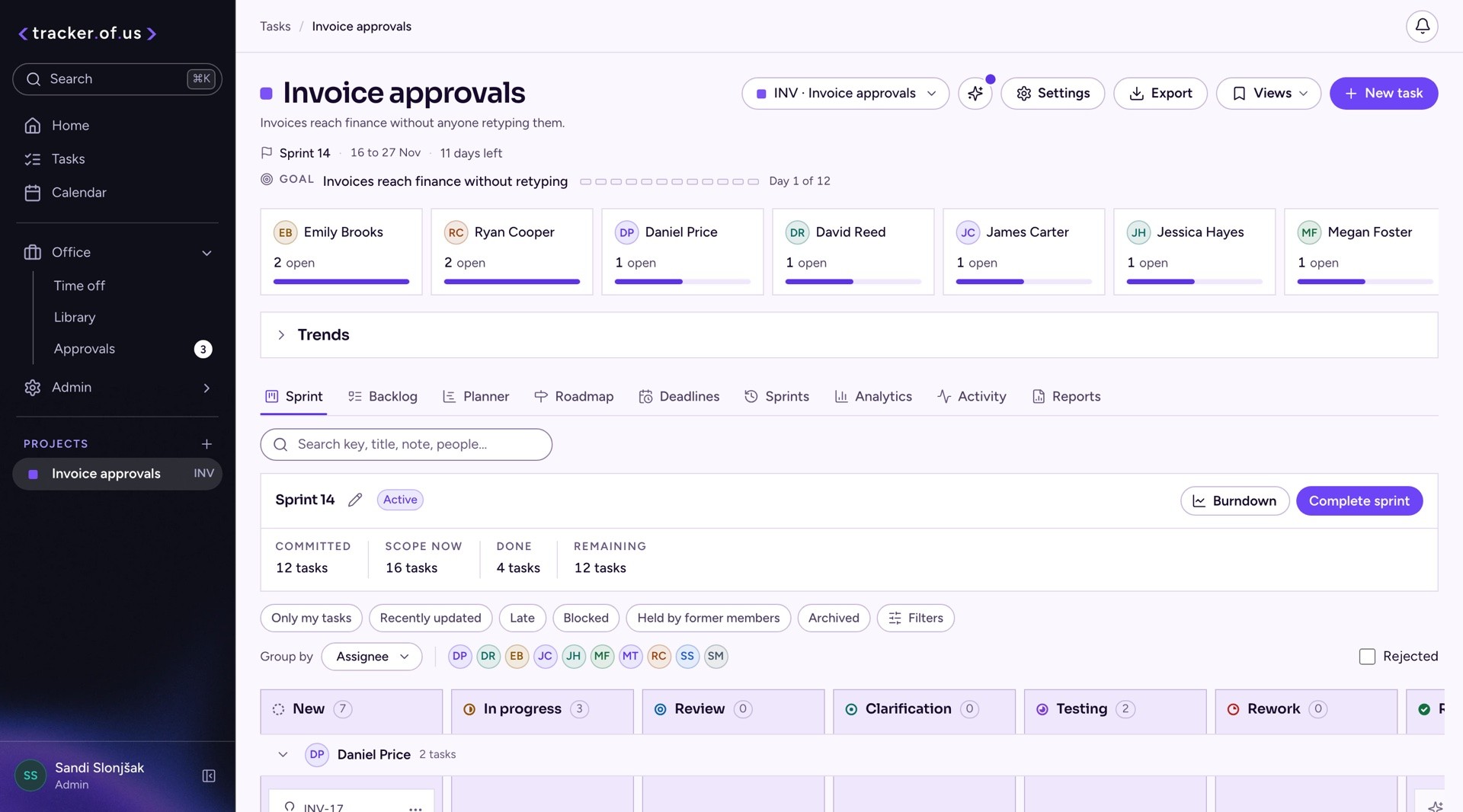
An invoice approvals project in Tracker Of Us: the sprint goal, open work per person and the board grouped by assignee.

Time off runs on the same idea

A request goes to one queue, someone approves it and the calendar changes. Home shows the approver what is waiting, so the request doesn't depend on anyone remembering to ask again.

Unused vacation carries over on January 1 and expires on a date each company sets, and Home warns before it does. The calendar exports a month or a week to Excel for payroll.

The same app also runs notifications, the company book library, capacity planning and finance admin. Employees see their own personal data, and accountants get a read-only list of employees.

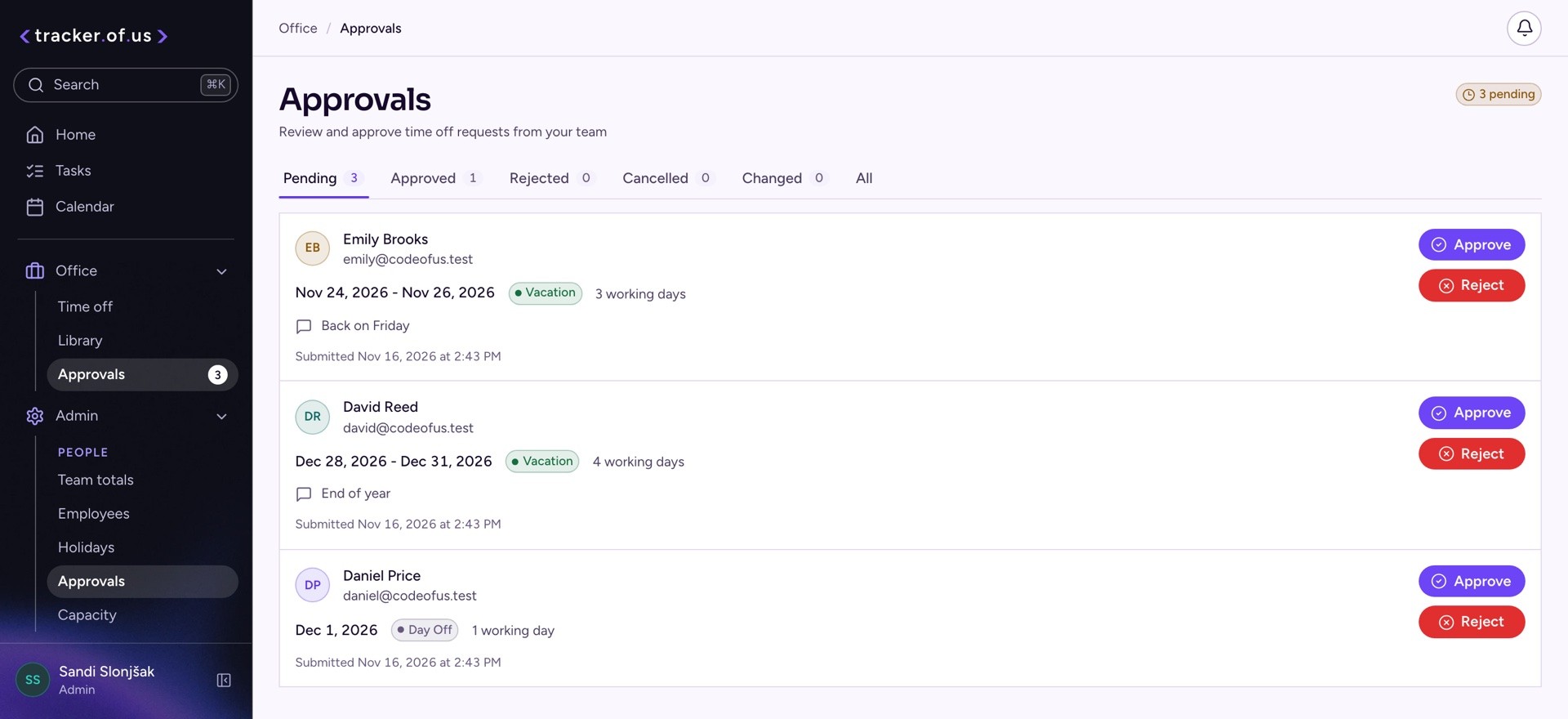
The approvals queue in Tracker Of Us, with three time off requests waiting for a decision.

What we left out, and why

Importing old tasks

The new app started empty. Old tasks stayed in the old tools, so moving data could not delay the first version.

Time tracking and velocity charts

We wanted to know where a task is waiting. Hours and velocity answer a different question.

A workflow per project

Every project uses the same statuses, so a task reads the same wherever you open it.

Why one app

A task tracker and a separate leave tool each do their own job. Neither can tell you that the person holding your urgent task is out on Thursday. One app can, and agents work in it under the same rules as people.

How long it took

The spec for the tasks module was approved on October 12, 2026. By October 16, tickets were going in. The first commit was in December 2025. Of the app's 421 commits since then, 299 landed in October 2026.

Where it stands

The team has used it every day since October 2026. By October 30 it held 65 team tasks, and 40 of them were closed. Most of them, 53, are about the app itself, so its own bugs get reported and tested in it.

It launches on production soon. Until then it runs on a staging environment, and real salary data stays out until the last database boundary is built.

We don't have an hours-saved figure yet, so we don't quote one.

For the technical reader

Two doors, one set of rules

People come in through the web app. Agents come in through an MCP endpoint. Both reach the same services, so an agent can never do more than the person whose token it holds.

PeopleSigned in with Microsoft Entra ID
AI agentsClaude Code and other MCP clients
Next.js appCalls the API through a proxy with a shared secret
MCP endpoint10 tools, personal tokens, 60 requests a minute
Spring Boot APIOne set of roles, readiness checks and version checks for both doors
PostgreSQLFlyway migrations, Envers audit history
Salary schemaSalary owner and accountants only
Next.js 16, Spring Boot 4 on Java 25, PostgreSQL 16, with 90 database migrations.

Three hard problems

Agents should do real work, but not sign it off

The problem

Agents are useful only if they can change tasks. A task an agent closed itself proves nothing, and a change with no visible author can't be trusted.

What we decided
Personal tokens, stored only as a hash and limited to chosen projects. Agents can move a task up to In testing. Testing and closing stay with people, and every agent change shows a via agent badge.
What it cost us
Tokens stop working after 30 days without a web sign-in, because only the web app can recheck Microsoft access.
Salary data in an app everyone uses

The problem

Employees, admins and developers all use this app. Being an admin must not mean seeing what colleagues earn.

What we decided
A separate schema with its own roles. Only the salary owner and the accountants they grant can read it. A normal admin gets a 403 like everyone else.
What it cost us
The separate database login isn't built yet. Until it is, we keep real salary data out, so that module is built but not in real use.

Production kept small on purpose

The problem

Building for scale nobody needs yet is easy. Every extra moving part is one more thing a small team has to run.

What we decided
One backend container and one managed database. No Kubernetes, no salary microservice and no Grafana until there is a real need.
What it cost us
Live updates and rate limits live in memory, so a second instance needs work first.

What happens when an agent tries to close a task

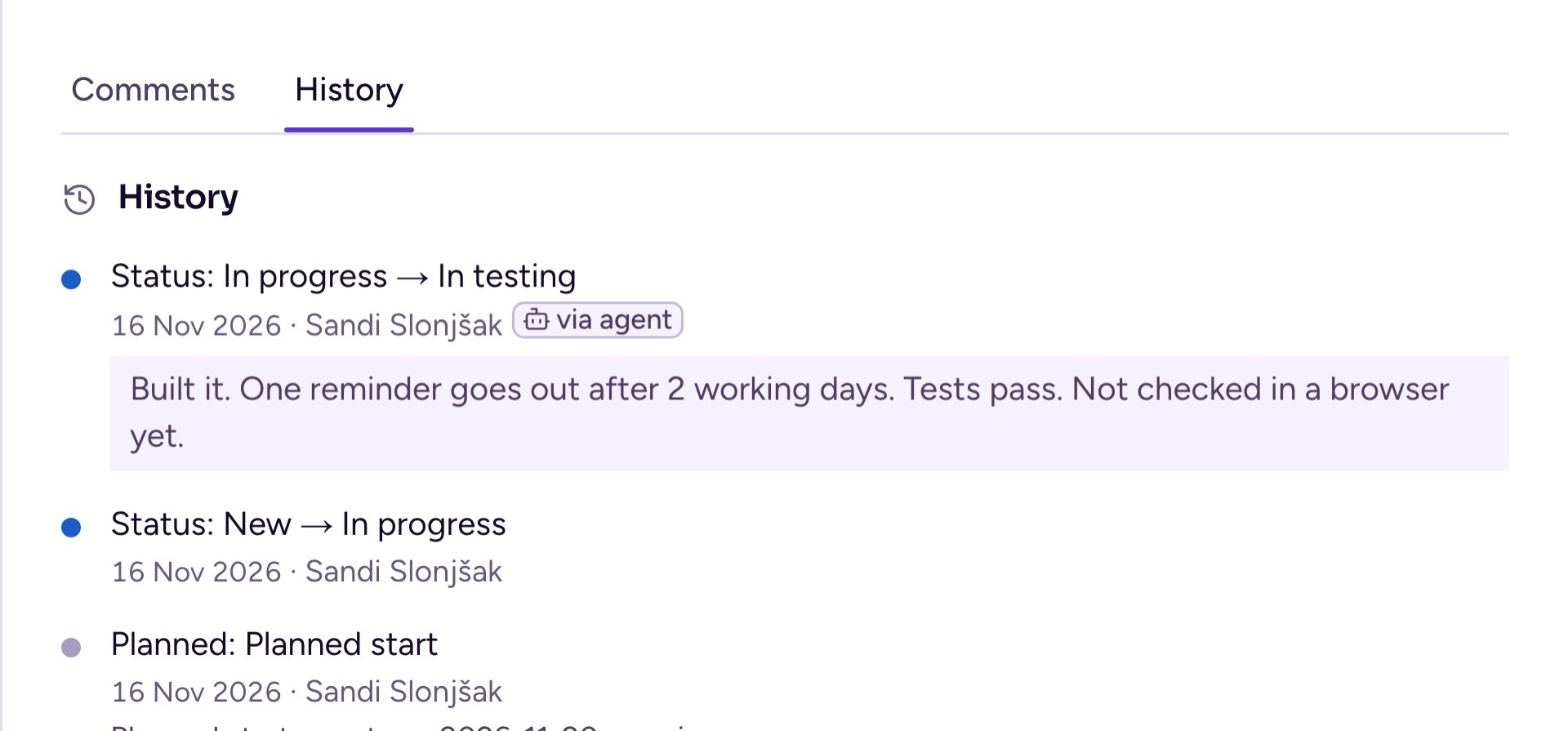
We connected an agent to a test copy of the app on November 16, 2026. It moved a task to In testing with a note on what it had checked, and the history marked that change. Then it tried to close the task, and the API said no.

move_task INV-4, status RESOLVED
{"error": "AGENT_NOT_ALLOWED",
"message": "Agents can move a task to New, In progress, Needs clarification or In testing. A person tests, returns and closes it."}
The history of a task in Tracker Of Us. The move from In progress to In testing carries a via agent badge.

How we checked it

The app has 4,304 automated tests, run on November 16, 2026. All 2,359 backend tests pass. In a full frontend run, 1,942 of 1,945 passed, and the 3 that ran out of time pass when run on their own. Browser tests run by hand before a flow changes, because they aren't in CI yet.

Six read-only reviews before the production move said "not ready to deploy". All six found the same hole: any employee could download colleagues' personal data. We fixed it the same day and added a test that keeps it closed.

What the agents did, and what people did

Agents co-authored 281 of the 421 commits. People decide what gets built, because no feature starts without an approved spec or plan. People also test and close the tasks, and the app enforces that for agents.

What this means for your process

Swap tasks for invoices or approvals and the structure stays the same. One owner at a time, a clock on waiting time, a history nobody rewrites and people signing off what agents prepare.

The First Workflow gives you a working version of your own process, built the same way and with the same limits.

Have a process like this?

Book a 20-minute call

You describe the process. If a First Workflow fits, you get a one-page proposal within 2 working days. If it doesn't, we say so.

Book a call

You'll talk to Sandi, our founder. No slides.

Not ready for a call? Send us the process in writing. We reply within one working day.

Free download

The First Workflow kit: find the process worth turning into software

Ten signs a process is ready, what AI can do in a back office today, a worksheet to price your process, build or buy and the questions to ask any software vendor. Seven pages, written for people who run operations.

Want our eyes on your process? Get a free scorecard
We use your email for this and, if you tick the box, the Letter. Unsubscribe with one click. See our privacy policy.
Book a 20-minute call